The Loopler Card Tier List
Rank by engine — speed, ghost, score, economy — then let the live tooltip overrule any letter on this page.
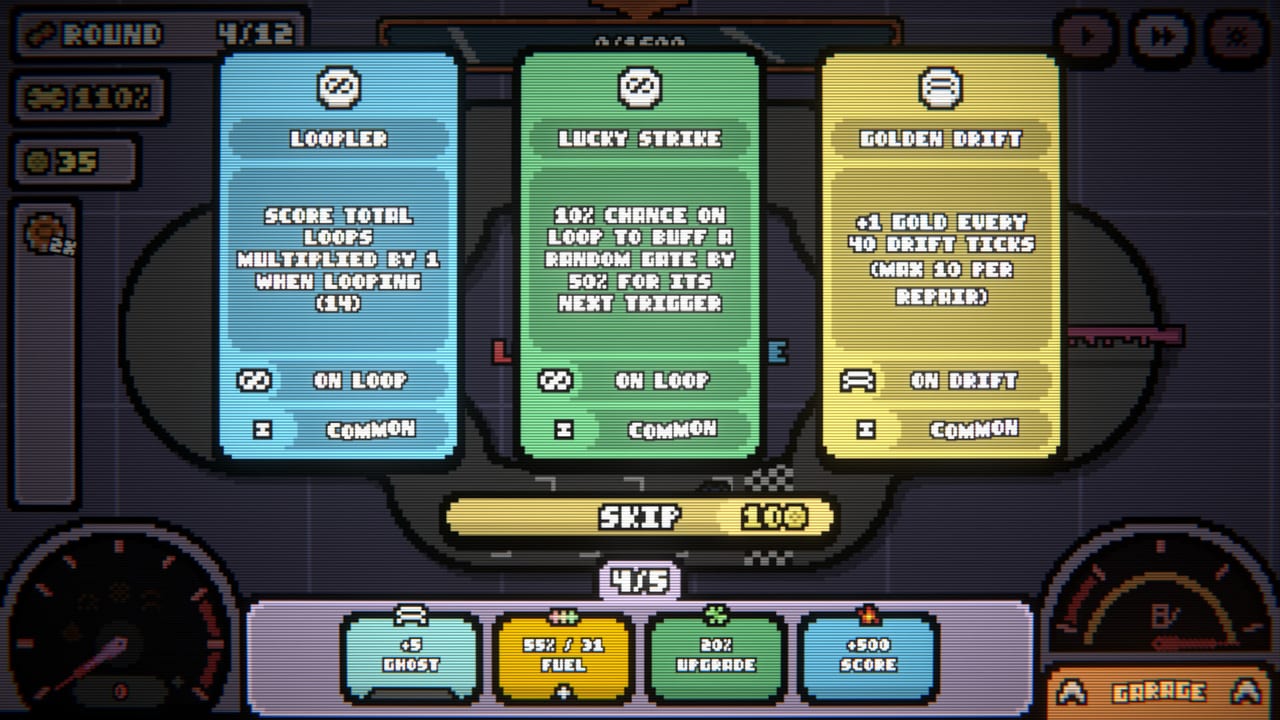
The Loopler ships fifty cards in 1.0. This page does not invent the missing names. It ranks engines, then slots the confirmed cards we can actually quote. If a pack shows you a card this list never mentions, read the tooltip: trigger (on loop, on drift, on pass, on empty tank, on start), resource (score, gold, fuel, boost, ghosts), and whether it talks to a gate you already planted. That reading is the real tier list. The synergy planner is a shop checklist for the same habit.
Letters are pick priority for the current Steam patch, not a forever ranking. S is take this when it matches the engine. A is strong support. B is the track or a challenge has to ask. C is skip unless you are plugging a specific hole. Demo-era boost-plus-refuel was so dominant that other engines felt fake; 1.0 still lets speed win, but ghosts and score are real finish conditions if you refuse to mix them. Cross-check the speed, ghost, and score pages before you copy an S pick into the wrong run.
How this list is ranked
A card’s letter is the answer to one question: if I already committed to an engine, is this the next gold I should spend? That is different from highest number on the art. Loopler can print a huge score total and still be the wrong pick on a lowest-loops board. Golden Drift can fund a god shop and still lose if you never placed a gate that cares about gold. Rank inside an engine, then ignore the other engines’ S cards.
Families you will see even when the name is new:
- On-loop — fire once per completed circuit. Fuel, gold, score multipliers, and luck rolls live here.
- On-drift — tick while the car is sliding. Gold and score both have drift versions.
- On-pass — fire when the car hits a gate or a point on the tarmac. Score gates love this family.
- Ghost spawn — extra cars, duration, or copy-pass rules. Worthless until you have something for the copies to hit.
- Boost-on-start — dump boost at round start so the first figure-eight is already fast.
- Trigger-other-cards — roll or chain another card. High ceiling, easy to brick if the rest of the tray is empty.
Upgrade ranks matter. Several cards change at rank 5 — Overfuel Injector had a rank-5 value bug in the demo — so do not treat a rank-1 tooltip as the whole story. If two cards share a family, keep the one whose trigger you already produce and sell the other.
Speed engine
Speed wins by finishing the goal in fewer loops, which is what the lowest-loops leaderboards measure. Fuel is the fail state. Boost is the accelerator. Cards that keep the tank honest or convert boost into permanent speed are the core.
S — Efficiency. Refuel 20% on loop. This is the clean on-loop fuel. It scales with how often you actually complete circuits, so it rewards the same thing the engine wants. Take it early, upgrade it, and stop panic-buying random refuel charms.
S — Reserve Tank. Refuel at 60% when the tank empties, and it ignores fuel efficiency. That last clause is the point. Efficiency as a stat decays the more you top up; Reserve Tank is the I-emptied-it-on-purpose insurance. Pair it with Efficiency so you empty less often, or lean on Reserve Tank when Oil Leak or a mean fuel track is ruining on-loop tops.
S — Turbo Fangs. Live text has described this as permanent speed tied to boost gained; the demo tooltip was rewritten so players would stop misreading it. In a speed run, permanent speed is the actual win condition. If the current tooltip still talks to boost, it is S. If a later patch moves it off speed, drop it. Always re-read Fangs after a patch.
A — Overfuel Injector. Fuel-family card with upgrade ranks. Treat it as A until the live text says it is doing something your tank is not already doing. Do not buy it as a second copy of Efficiency without reading the rank-5 line.
B — off-engine score cards in a speed run. A fat on-loop score card is bait when your plan is to spend fewer loops, not fatter loops.
C — ghost-spawn cards in a speed run. Extra cars that you cannot feed will steal attention and gold.
Place boost gates first on the layout. Speed cards do not replace that order. Garage Boost Cap and Fuel Tank on the car list decide how hard this engine can push before the tank dies.
Ghost and score engines
Ghost cards are S only after you have a pass worth copying. A ghost that hits empty tarmac is a decoration. Draft spawn and duration once a ghost gate or a dense on-pass row exists. Until then, ghost-spawn is B at best. Lucky Strike is the named glue card ghosts (and everyone else) can use: 10% on loop to buff a random gate, and that gate’s next trigger is 50% stronger. That is an A in any engine that already planted three or more gates, and a C if you are still staring at empty slots. It is not a ghost card; it is a gate-buff card that ghost rows love because copies will hit the buffed gate too.
Trigger-other-cards sit next to ghosts. A card that rolls another card on loop is A when your tray is already a ghost engine, and C when the random target is a leftover gold card you forgot to sell.
S for score — Loopler. Scores total loops, multiplied, when you loop. This is the namesake on-loop score card. It wants many loops, which is the opposite of a lowest-loops speed board and the same as a score build that plans to stay on the eight. Upgrade it. Do not pair it with a plan that tries to win on loop two.
A — on-pass score cards and score-gate talkers. If the tooltip pays on pass and then grows, it is doing the same job as a score gate. Take it when you already placed score gates; skip it when you placed boost-first and never look back.
B — Lucky Strike in a pure score row. The random gate buff is less reliable than another on-loop score rank, but it is still a multiplier on something you already built.
C — fuel-only cards once the tank is solved. Efficiency is S in speed and C in a score run that already has a Reserve Tank and a fuel gate. Score engines still die to empty tanks. One fuel card is support, not a second engine.
Economy and glue
Gold does not finish a round. Gold buys the thing that does. Rank economy cards as support, never as a finish condition. Demo feedback was that gold was too easy and the shop became the only decision; do not rebuild that mistake on purpose.
A — Golden Lap. +1 gold on loop. Simple, on-loop, scales with the same action you already want. First economy pick for most engines.
A — Golden Drift. +1 gold every 40 drift ticks, max 10 per repair. This is the drift-economy card. It is S on a layout that actually drifts — Hotdog’s curves, some figure-eights — and B on a tight oval where ticks never accrue. The per-repair cap means you do not print infinite gold by never visiting the pit.
B — Lucky Strike as economy. It does not print gold. It makes a gold gate or a score gate worth more, which is only economy if you already own that gate.
C — buying a third gold card instead of a gate. The shop is not the win condition. Sell cards that do not talk to your gates. A five-card tray with two engines is a C-tier run even if every name on this page is S in isolation.
When a pack offers three names you recognize, take the one that matches the build page you opened before the run, not the one with the fancier verb. Then go place or upgrade a gate. Cards without a track sentence are just stickers. For endless contracts, check How to Go Infinite once the engine actually prints; for charm multipliers that sit on top of these cards, use the charm list.
Frequently Asked Questions
Quick answers to the most common questions.
Is Loopler always an S-tier card?
Only in a score build that wants many loops. On a lowest-loops speed board it is often a skip. Rank by engine, not by the name on the art.
Should I take Efficiency or Reserve Tank first?
Efficiency if you are completing loops and topping up. Reserve Tank if you empty the tank or Oil Leak is wrecking fuel efficiency. Many speed runs want both; see the speed build.
Where is the full list of all 50 cards?
In the live game. This page names confirmed cards and the six families the rest belong to. If a tooltip disagrees with a letter here, trust the tooltip and the synergy planner.
Is Lucky Strike worth an early pack?
Not before you have gates. The 10% on-loop buff needs something to hit. Plant a row first using the gate tier list, then Lucky Strike becomes A.
Do economy cards win runs?
No. Golden Lap and Golden Drift buy the engine; they are not the engine. Spend the gold on gates and the matching build, not on a third gold card.