How to Go Infinite in The Loopler
Outrun a doubling goal with one engine — speed, ghosts, or score — before overdrive is your only trick.
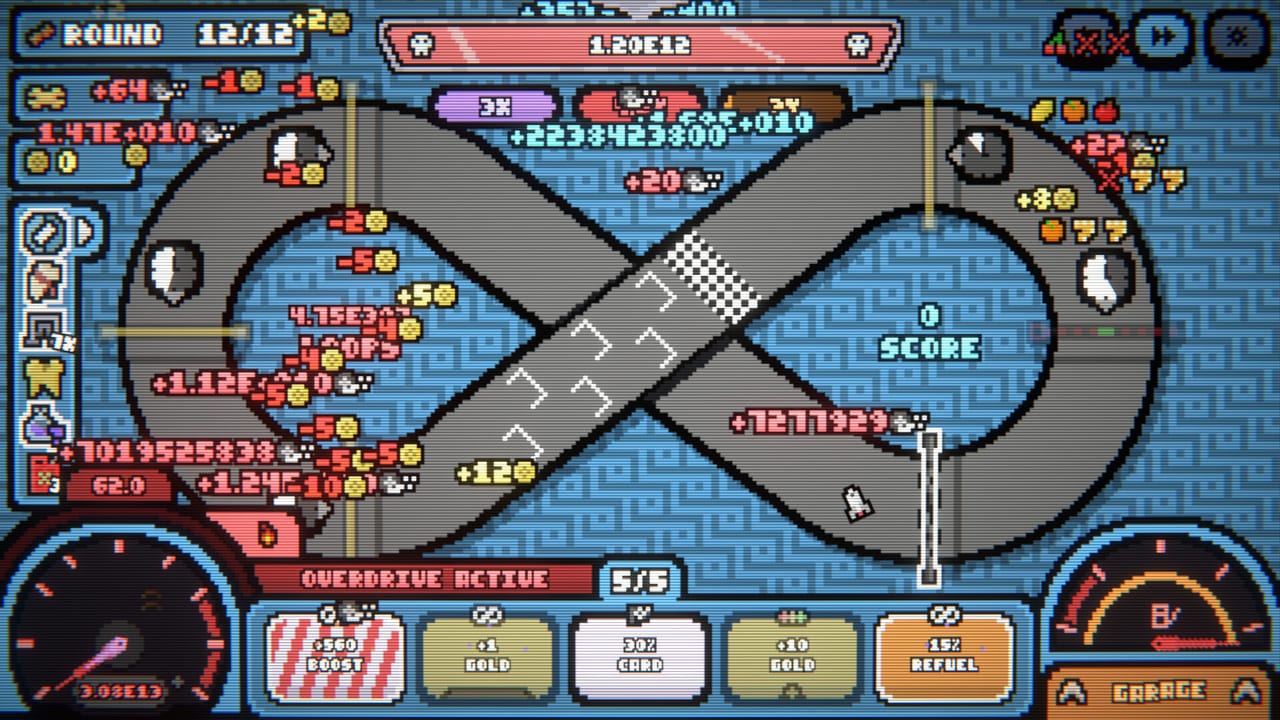
Infinity in The Loopler is not a secret ending you unlock by waiting. It is a scaling problem. A normal track asks you to fill a score bar twelve times. Infinity Mode keeps handing you the next contract after that, and the number stops looking like a score and starts looking like notation. This page is the breakpoint guide for Steam 1.0: which engines outrun a doubling goal, what overdrive actually is, and why mixing three half-plans dies the moment the bar jumps.
Finish a clean 12-round clear first. Use the walkthrough if you still panic-buy every pack. Infinity Mode is the same HUD, the same fail states (empty fuel, broken durability), and a ruder goal. Garage parts and loadout slots make the attempt repeatable; they do not replace an engine. See Loadout and meta.
What “infinite” actually means
Players use the word for three different things, and mixing them up wastes runs.
1. Clearing the 12-round contract so hard the last bars fill in seconds. That is a solved engine, not Infinity Mode. It is still the right rehearsal. If round 12 is a struggle, you are not ready to keep going.
2. Infinity Mode itself. After the standard contract, the mode continues. Goals keep climbing. Scores move through five figures, then past the point where the HUD would rather write scientific notation than a wall of zeros. The car is still looping. You are still not steering. The only question is whether each loop is worth more than the last by a bigger ratio than the goal’s jump.
3. Cosmetic “the sprite disappeared” speed. Stored speed can sit in the tens or hundreds of thousands while the needle looks capped. 1.0 even changed the speedometer text to show stored speed instead of the visual cap. That is a speed build flex, and it is one valid infinite engine, not the only one.
Demo-era talk treated “progress to infinity” as a percentage after a clear. 1.0 ships a dedicated Infinity Mode plus the usual 12-round tracks. Do not grind demo percentages as gospel. Grind a scaling sentence: this card or gate makes the next loop strictly better, forever.
Overdrive is the other word people confuse with infinite. Overdrive can activate late when durability is gone. The car gets a last sprint; a bar fills; you either beat the contract or you explode. It is a fail-forward, not a scaling engine. If your “infinite” plan is “hit overdrive every round,” you are one unlucky Oil Leak from a dead run. Oil Leak slams refuel efficiency. Infinite kits that live on refuel hate that event. Infinite kits that live on boost or ghosts can sometimes ignore it.
The three engines that outrun a double
Gold is not an engine. Gold buys the engine. Demo players learned that the hard way when gold was too easy and the shop became the only decision. Mheep accepted that feedback and reworked it for 1.0. History, not current gospel: you still need gold, you just cannot finish on gold.
Speed. Place boost gates first so every later trigger happens more often. Stack speed per loop. Ignore most score cards; the bar fills because you loop so many times that even a small per-loop score explodes. This is also how you attack lowest-loops boards — the infinite version just keeps going after 12/12. Fuel is the fail state. Boost Cap, Top Speed, and Acceleration in the garage are the meta knobs. Full route: speed build.
Ghost. Extra cars are extra hits. Duration keeps those cars on the eight long enough to pass every gate. Ghost gates and spawn cards turn one loop into a crowd. Score happens because the swarm stampedes the on-pass slots, not because you drafted a Loopler and prayed. When the goal doubles, you need more ghosts or longer duration, not a random gold charm. Full route: ghost build.
Score. Score gates that tick on pass and grow, plus the Loopler card (score total loops multiplied when looping), plus on-pass value. This engine wants fewer, fatter loops rather than a blur. It loses lowest-loops boards to speed on purpose. It wins high-score boards and some Infinity attempts where the bar is a number, not a lap counter. Full route: score build.
Mixing engines usually fails when the goal doubles because each engine wants different gate order, different charms, and different late-game spends. A boost-first track with a half-built score gate and one ghost is three tutorials glued together. Pick one. Support it with fuel or gold. Stop.
Lucky Strike (10% on loop to buff a random gate +50% next trigger) is a multiplier of whatever you already planted. It is excellent on a committed line and noise on a mixed one. Lucky gates double their value on upgrade — that is an Infinity spend. Chain gates exist as an archetype for combo finishers once the track is already a sentence. Coupon is multiplicative. Skull raises the goal; Pacifier lowers it. Those two charms are demo daily/weekly exclusives that may still appear as a challenge idea in 1.0. Skull is anti-infinite unless you are hunting a longer shop window. Pacifier is a cheat code for scared bars. Details: charm tier list and Challenges.
Garage parts that help Infinity are the ones that raise the ceiling of the engine you already run. A Leaky Pump with no base benefit can still roll +2% lucky chance, −2.5% fuel consumption, +23% boost cap, or an ice-cube Frozen Threshold. Roll toward Boost Cap and Fuel Efficiency for speed infinites; toward Durability and Drift Grip if ghosts need time on track; toward whatever your score line actually reads. Do not chase a rainbow part.
The embedded video is GrayStillPlays racing the loop until the goal is infinity — a popular public playthrough, not a balanced 1.0 tutorial. Demo numbers may differ. Use it to see what a numbers-go-up crash looks like, then come back to current Steam tooltips. When the HUD starts writing notation, you are in the right neighborhood. When the bar still crawls, you do not need more gold — you need a gate order that compounds. Check the gate tier list and the synergy planner before the next pit.
Frequently Asked Questions
Quick answers to the most common questions.
Is Infinity Mode the same as beating round 12?
No. A 12-round clear is the standard contract. Infinity Mode continues past that and keeps scaling the goal. Rehearse with the walkthrough first.
Does overdrive make you infinite?
No. Overdrive is a last sprint after durability hits zero. Treat it as a fail-forward, not a plan. HUD details are in How to Play.
Which build goes infinite most reliably?
Speed, ghost, and score all can. Mixed kits usually cannot. Start with a speed build if you want lowest loops, or a score build if you want fat numbers.
Why do scores turn into scientific notation?
Because a scaling engine outran the goal hard enough that the HUD stopped printing a wall of zeros. That is the point of Infinity Mode, not a bug.