The Loopler Score Build: On-Pass Scaling
Plant score gates, upgrade the Loopler card, and make each pass worth more instead of looping forever.
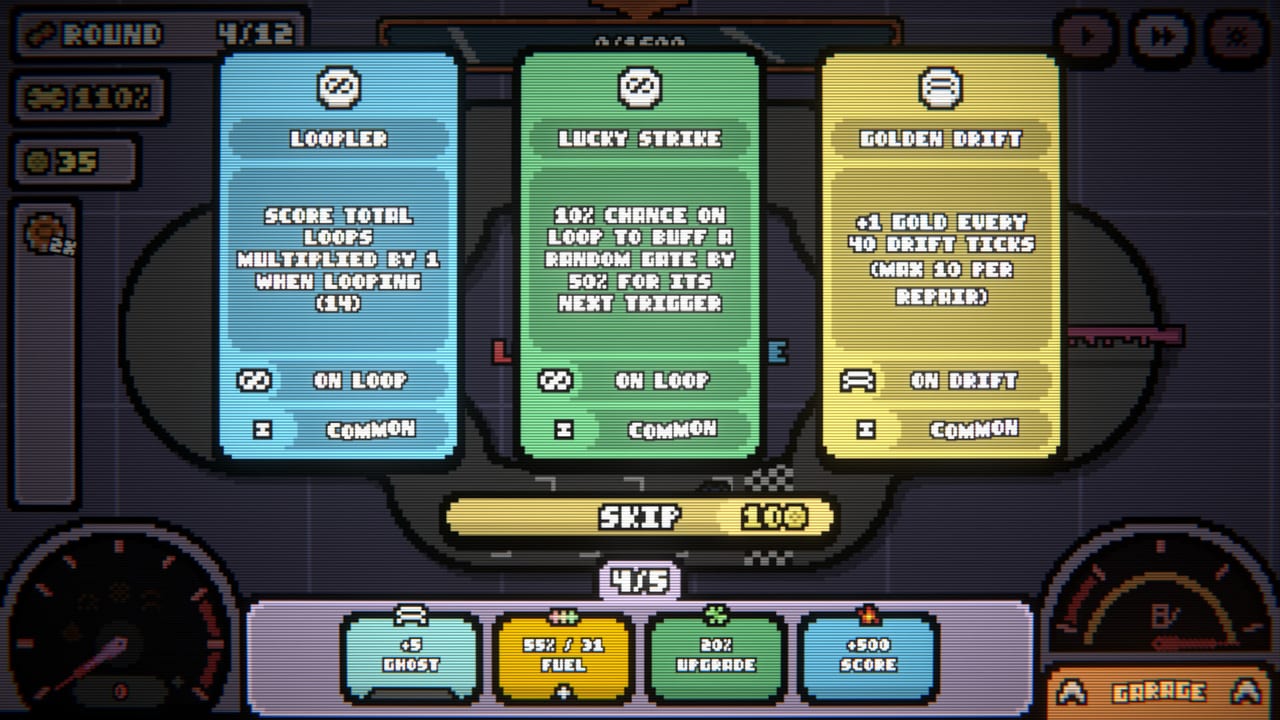
A Loopler score build fills the bar because each pass is expensive, not because the car became a blur. That is the opposite of a speed build and only cousins with a ghost build (ghosts help when they stampede score slots, not when they exist for their own sake). Gold is still support. Fuel is still a fail state. The win condition is still the score-versus-goal bar. The difference is the sentence you plant on the tarmac: on-pass value that grows.
This page has no embedded video on purpose. The public highlight reel for The Loopler is mostly speed breaks and ghost floods. Score is the quieter engine, and it is the one that looks like a deckbuilder. If you came here from Balatro comparisons in the review, this is the build that comparison was pointing at.
Score gates, Loopler, and on-pass families
Score gates tick when something passes them. Many of them scale: a small on-pass value that increases after each trigger, or a share of the base loop score that grows. That scaling is the engine. A score gate that never gets upgraded is a round-1 toy. A score gate that has been bought up while the rest of the track supports it is how round 6’s five-figure goal still looks polite.
Gate order for this line is not “boost first.” Boost-first is a speed sentence. For score:
- Score slots where traffic is guaranteed. The live car must hit them every loop. Inspect Track before you drop. Empty decorative slots are how this engine dies.
- Fuel or refuel so the expensive passes keep happening. A score palace with an empty tank is a museum. One fuel gate is support.
- Gold only to fund upgrades. You will spend more here than a speed line because upgrading the score gate is the build. Lucky gates double their value on upgrade; they belong once a score gate exists to buff.
- Ghost as optional multiplier, not a second plan. Extra cars hitting a score gate is free math. Extra cars with no score gate is a ghost build you started by accident. Chain is a finisher.
Archetypes: gate tier list. Layouts change slot counts; Infinity, Hotdog, and Crown are not interchangeable canvases. Rankings: tracks page.
The namesake card is Loopler: it scores total loops multiplied when looping. That is an on-loop score verb, not an on-pass verb, and it still belongs in this family because it makes the loop itself a payload. Upgrading Loopler (the multiplier stepping up) is a real spend. Lucky Strike (10% on loop to buff a random gate +50% next trigger) is excellent when the random target is a score gate. Golden Drift (+1 gold every 40 drift ticks, max 10 per repair) is shop fuel. On-pass cards that raise the value of passing a gate are the rest of the deck. On-loop speed cards are usually skips; they steal gold from the upgrade that would have doubled your on-pass tick. Families: on-loop, on-drift, on-pass. Rarities include Common. Rankings: card tier list.
Charms should multiply score, cheapen the shop, or lower the goal. Coupon is multiplicative — this is the build where that wording matters. Pacifier (−10% goal) is a legal shrink of the bar. Skull (+10% goal) is a flex for people who want a longer shop window and a meaner contract; it is anti-clear unless your on-pass scaling is already ridiculous. “Gates 10% chance to trigger twice” is a score charm because a scaling gate that fires twice grows twice. Demo-era exclusives may still show up as challenge ideas; see Challenges and the charm tier list.
When score loses to speed on the boards
Steam leaderboards include lowest loops. Score builds lose those boards on purpose. A fat on-pass kit wants enough loops for the scaling to wake up. A speed kit wants the bar full in as few laps as possible. If your trophy is lowest loops, leave this page and go plant boost gates. If your trophy is a high score, a long Infinity attempt, or a clean 12/12 on a mean difficulty, stay.
The HUD tells you which run you are actually on. Bottom kit tiles: Ghost / Fuel-Refuel / Upgrade / Score. Score should be the loud one. Upgrade chance is the friend of this engine because upgrading the score gate or the Loopler card is the compounding step. If Boost is loud and Score is a footnote, you drafted a speed pack and called it a score run. Glossary: How to Play.
Goal math is why mixing fails. Round 1 often asks for 200. Round 6 can already be five figures. A half-speed, half-score kit fills round 4 and starves on round 8 because neither engine was upgraded enough to beat the jump. Demo players felt this as “the shop is the only thing that matters” when gold was too easy. 1.0 reworked that. You still need gold; you just cannot finish by being rich. Skip packs that do not talk to on-pass or Loopler. Skip can cost 100. Pay it.
Garage knobs: Durability so you live long enough to upgrade, Fuel Efficiency so the expensive passes continue, Drift Grip if on-drift gold is funding the shop. Boost Cap is optional. Frozen Threshold is a layout concern. A Leaky Pump that rolls lucky chance helps Lucky Strike and lucky gates; a boost-cap roll is a distraction. Enable score-family cards and gates in loadout; disable the speed bait you keep accidentally buying. See Loadout and meta.
Cars: yellow-style gold equal to durability/10 on round complete is a shop engine for this line. Blue-style extra starting durability is a safer first hour while the score gate is still tiny. Neither identity prints score by itself. Rankings: car tier list.
Node-map routing is the same as any other 12-round clear: prefer pits when you have upgrade gold, skip Oil Leak if refuel is holding the palace up, take durability rewards when the percentage is yellow. Walkthrough pacing: walkthrough. When the on-pass number is growing every lap and the bar dumps without the sprite vanishing, you have a score engine. That is the kit you take into How to Go Infinite if you want notation instead of a blur.
Frequently Asked Questions
Quick answers to the most common questions.
What does the Loopler card do?
It scores total loops multiplied when looping. Upgrade the multiplier. It is an on-loop score card, not a steering tool. Other families sit on the card tier list.
Why do score builds lose lowest-loops boards?
Those boards reward filling the goal in as few laps as possible. Score wants scaling time. Race lowest loops with a speed build instead.
Should I place boost gates first on a score run?
No. Boost-first is a speed sentence. Plant score gates on guaranteed traffic, then fuel, then gold. Slot theory is on the gate tier list.
When is Pacifier worth buying?
When the bar is the problem and your on-pass scaling needs two more rounds to wake up. Skull does the opposite. Challenge exclusives are covered in Challenges.